
fuse box

A Guide To Your Fuse Box

In these strange times, we are all spending a lot more time at home and in the garden (if we are lucky enough!)  So we thought we’d give you a mini guide to something we all have in our homes and probably take for granted that they’re keeping us safe.

Fuse Boxes – also known as Consumer Units – are used to control and distribute electricity around our homes.

You probably know where your fuse box is located in your home.  It is important in case we ever need to turn the electricity off in an emergency.

A fuse box contains three things:

  1. Mains Switch

This allows you to turn off the electricity supply, and so should be easily accessible.  Some homes will have more than one mains switch if there is more than one fuse box.

2. Circuit Breakers or Fuses

Most homes built after 1960 will have circuit breakers. These are automatic protection devices that switch off a circuit if they detect a fault.  Despite being a similar size to fuses, they offer more precise protection.  If they “trip”, you can reset the switch after finding and correcting the fault.

Fuses have a piece of special fuse running between two screws.  If a fault occurs, or in the event of an overload, the fuse wire will become hot and melt.  The melted fuse then breaks the circuit, disconnecting it and keeping you safe.

3. RCDs

RCDs (residual current devices) are switches that trip a circuit under certain conditions and disconnect the electricity supply.  If it detects an imbalance in current, or electricity flowing down an unintended path, it will switch the circuit off, reducing the risk of death or serious injury from an electric shock.

If you have a wooden back on your fuse box, a mixture of fuses and circuit breakers, or no RCD protection, then you might benefit from upgrading to a new consumer unit that would offer you more protection.  It is also worth considering if you are planning an extension or an improvement project or your fuse box is overloaded.

A professionally installed consumer unit by a certified electrician will improve your electrical safety as well as put your mind at rest by checking the integrity of the existing circuits in your property.

Fulcher Edwards carries out all types of electrical services, including fuse box replacement in homes in and around St. Albans. Why not give us a call us today for a free quotation on 01923 616985 or drop us an email on our Contact Us Page.
Read more

Your Fuse Box Explained

All homes have a fuse box, otherwise known as a consumer unit. It is our homes electrical hub as it controls and distributes the electricity around the home. Your fuse box is your first point of call if you need to turn your electricity off in an emergency. Or if the electricity in your house suddenly stops working.

We would hope that you all know where you fuse box is located, but how many of you understand what each switch does?

Understanding Your Fuse Box

At an initial glance you fuse box can look complicated. Therefore we hope the following explanations will help you feel more comfortable managing your fuse box, especially in an emergency.

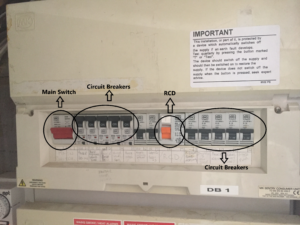
  1. The main switch: The main switch will enable you to instantly turn off your homes electrical supply. This will be the switch to flick off in the event of an emergency. However beware that if you have electric storage heaters you will have a separate fuse box for these. Therefore they will have their own main switch which you would also need to turn off to cut all electricity in your property.
  2. Residual Current Device (RCD): The RCD is the main safety feature within your fuse box. RCDs are a sensitive switching device that quickly turn off electricity when danger arises to reduce the risk of death or serious injury. RCDs turn off electricity in a fraction of a second. Last year we did a blog about the importance of RCD protection, therefore you can read that blog post HERE to find out more.
  3. Circuit Breakers: Circuit Breakers will automatically switch off a circuit if it detects a fault. By looking at your fuse box you would be able to see if a circuit breaker has ‘tripped’ as one or more of the switches would be flicked down. You can easily reset the switches yourself by flicking them back up, however its important to first identify the initial fault.
  4. Fuses: Older fuse boxes may have fuse wiring in place of circuit breakers. Similarly to circuit breakers they switch off a circuit if a fault is detected. However it does this by the fuse wiring overheating and melting which then switches off the circuit. Fuse box replacement in St Albans, London, Hertforshire

The above photo shows a modern fuse box which I have labelled accordingly. As explained above, older fuse boxes would have fuse wiring in replace of circuit breakers. We recommend all family members have familirisation with the workings of the fuse box.

Older homes might still have a fuse box which dates back to the 1960s. This can be identified if there are cast iron switches, a wooden back, and fuses. We would highly recommend you get this updated to a modern fuse box.

If you would like further advice or think your fuse box needs updating, please do not hesitate to contact us HERE.

Read more